
Bitcoin’s simpler to understand—it’s digital money, that’s it. Ethereum’s more complex with smart contracts and DeFi applications, but offers higher growth potential (720% since 2020 versus Bitcoin’s 442%). Bitcoin transactions are slower (7 TPS) and pricier during congestion, while Ethereum’s faster (25-47 TPS) with improving fees. For absolute beginners, Bitcoin’s straightforward approach wins. For tech-savvy newbies with patience for learning curves, Ethereum’s versatility might pay off. The choice depends on your comfort with complexity.
Understanding the Fundamental Differences Between Bitcoin and Ethereum

Newcomers to crypto often get confused. They see Bitcoin and Ethereum as basically the same thing. They’re not.
Bitcoin fundamentals center on being digital money. Period. It’s designed for one job: transferring value securely with a capped supply of 21 million coins. Simple, reliable, boring—and that’s the point. The Bitcoin ledger system solely tracks financial transactions, maintaining its streamlined focus.
Bitcoin thrives on simplicity—digital cash with a fixed supply cap. Nothing more, nothing less.
Ethereum features blow past these limitations. It’s a whole computing platform, not merely currency. Smart contracts let you build apps right on the blockchain. DeFi, NFTs, tokens—all that fancy stuff lives here. Ethereum’s transition to Proof of Stake in 2022 dramatically reduced its energy consumption while improving scalability.
Think of it as programmable money versus just… money.
One’s a calculator, the other’s a smartphone. Same category of device, wildly different capabilities. Bitcoin transactions can take 10 minutes to an hour to complete depending on network congestion. Your call which matters more to you.
Evaluating Price Stability and Investment Potential for New Crypto Users

Bitcoin’s been less jumpy lately, with a 2.1% volatility index compared to Ethereum’s 4.6% in 2025.
Less drama, more stability. Bitcoin’s hitting resistance at $70,000 while Ethereum peaked at $4,120. Solid numbers, but different stories. Proof of Stake has made Ethereum more energy-efficient since its 2022 transition.
If you’re watching market analysis, the math is clear. Ethereum’s outperformed Bitcoin with a 41.9% YTD return versus Bitcoin’s 32.3%.
Since 2020? Ethereum’s up a whopping 720% while Bitcoin trails at 442%.
Bitcoin’s the store-of-value play. Ethereum’s the utility powerhouse. Both are gaining adoption globally. Ethereum processes significantly more daily transactions with 1.74 billion transactions in the first half of 2025 alone.
Tech upgrades keep pushing them forward, though Ethereum’s innovations seem to drive more excitement. Despite recent ETF outflows of $795.6 million, retail traders remain bullish on Ethereum’s future price potential.
Transaction Speeds and Fees: What Beginners Need to Know
When diving into crypto transactions, how quickly can you actually use your money? It matters. A lot.
Bitcoin crawls at just 7 transactions per second. Painfully slow. Ethereum? Much better at 25-47 TPS thanks to its improved transaction throughput. For context, Solana blasts past both with 30,000 TPS. Ridiculous difference. Solana achieves this through its innovative Proof of History mechanism. The transaction speeds align with each cryptocurrency’s consensus mechanisms, which is a key technological difference between them. Unlike spot ETFs, these networks process transactions continuously rather than just during market hours.
Fee structures vary wildly too. Bitcoin’s fees spike when networks get congested—making small transactions basically pointless. Ethereum’s gas fees aren’t perfect either, but Layer 2 solutions have made them more manageable in 2025.
Transaction fees can make or break crypto’s usability—when networks jam up, your coffee purchase could cost more in fees than the drink itself.
Want confirmation? Bitcoin makes you wait about an hour for full security. Ethereum finalizes in just 5.4 minutes.
The bottom line? Ethereum’s faster speeds and (generally) lower fees make daily transactions less of a headache for newcomers.
Learning Curves: Comparing Ease of Use and Technical Complexity
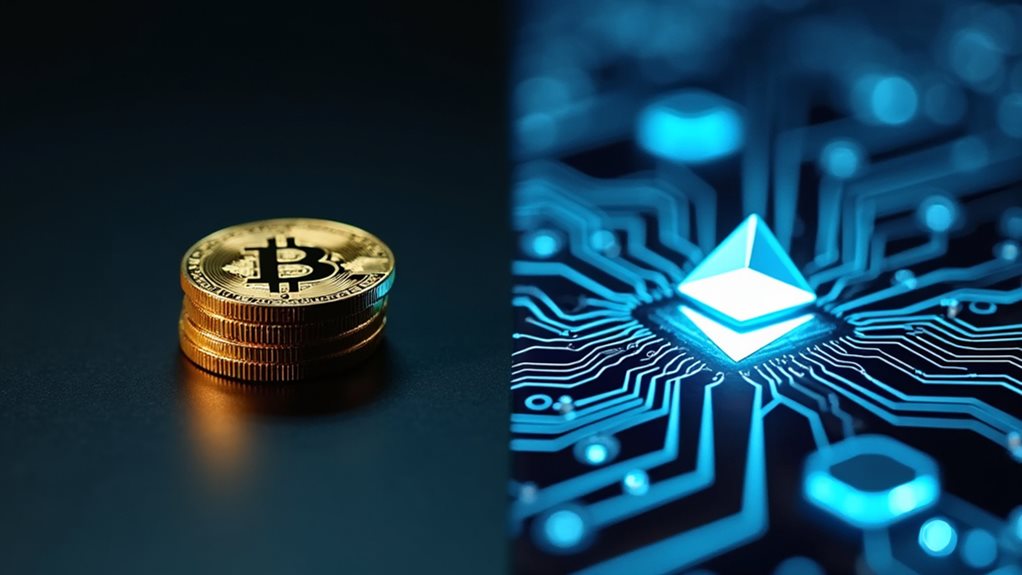
How drastically different is the learning expedition between these two crypto titans?
Let’s be real—they’re worlds apart.
Bitcoin’s simplicity is its strength. You’ll grasp basic transfers quickly. No fancy bells and whistles here, merely a straightforward UTXO model. Hardware wallets provide extra security for both cryptocurrencies when storing assets offline.
Yeah, it’s still technical, but the user experience is focused on one thing: moving value.
Ethereum? Buckle up. You’re facing gas fees, smart contracts, and token standards. Ethereum introduces gas as incentive for miners to process complex transactions, with fees calculated based on computational effort.
The onboarding challenges are steeper because you’re not only sending money—you’re potentially interacting with complex applications. Bitcoin, created in 2009, has had more time for user interface refinement compared to Ethereum’s 2015 launch.
Technical support exists for both, but Ethereum demands more user education.
Your wallet isn’t merely a wallet—it’s a portal to DApps.
Simple truth: Bitcoin’s like driving an automatic. Ethereum? You’re learning to fly a plane.
Environmental Considerations and Consensus Mechanisms

The environmental toll of cryptocurrencies represents perhaps the starkest contrast between our two digital contenders.
Bitcoin is an energy hog. Full stop. It devours as much electricity as entire countries—Poland, for reference—thanks to its Proof-of-Work consensus mechanism that requires massive computational power. A single Bitcoin transaction can consume energy equivalent to what a U.S. household uses in one to two months. With a market cap exceeding $1.3 trillion, Bitcoin’s environmental cost has grown alongside its value.
Ethereum? Totally different story. Since moving to Proof-of-Stake, its carbon footprint plummeted to roughly what 100 American households produce yearly. That’s it. Despite the industry’s quantum computing threats, Ethereum’s efficient consensus mechanism remains secure.
The environmental impact extends beyond electricity.
Bitcoin mining gulps down water for cooling and demands specialized infrastructure that strains power grids.
Meanwhile, Ethereum runs on standard servers with minimal resource needs.
Let’s be real—if you’re even slightly concerned about climate change, this comparison isn’t even close. Different planets, different universes.
Getting Started: Platforms and Resources for First-Time Buyers
Now that we’ve settled the environmental score, you’re probably wondering: “How do I actually buy these things?”
Entering the crypto world feels overwhelming at first—like walking into a casino where everyone speaks a different language.
Platform selection matters. Coinbase offers a beginner-friendly experience with solid regulatory compliance, while Binance attracts users with lower fees. Advanced trading charts are available on both platforms to help track market movements.
Choose platforms like people choose bars—some want safety regulations, others just want cheap drinks.
Your payment methods options typically include bank transfers and cards, with varying fees.
For wallet types, consider Zengo if you’re terrified of losing seed phrases. Hardware wallets like Ledger offer better security but cost more. Many beginners benefit from using non-custodial wallets that provide direct ownership of your cryptocurrency.
Yeah, security features matter.
Educational resources abound on these platforms—tutorials, forums, even demo trading environments. Community support can be surprisingly helpful (or completely useless, depending on who you ask).
The user experience differs dramatically between platforms. Choose wisely.
XXKK Exchange provides a unique advantage with its ability to trade both crypto and stocks, making it easier for beginners to diversify investments while learning.
Frequently Asked Questions
Can I Convert Bitcoin to Ethereum Directly Within a Wallet?
Yes, you can convert Bitcoin to Ethereum directly within many wallets. They offer built-in wallet conversion features that connect to liquidity providers, enabling direct exchange without leaving your app or compromising security.
How Do Taxes Work for Cryptocurrency Earnings in Different Countries?
Crypto tax rules vary widely by country. You’ll face different rates from 0% to 55%, and holding periods matter. You must follow cryptocurrency regulations and complete tax reporting based on your residency status.
What Happens to My Crypto if the Exchange Goes Bankrupt?
You’ll likely become an unsecured creditor, potentially losing access to your funds. Exchanges rarely offer robust crypto insurance, so consider hardware wallets for better exchange security and protection against bankruptcy risks.
Are Hardware Wallets Necessary for Small Investments in Bitcoin or Ethereum?
Hardware wallets aren’t strictly necessary for small investments, but they offer considerable security benefits. You’ll gain peace of mind knowing your crypto is protected from online threats, even if your investment is modest.
How Do Crypto Inheritance Plans Work if Something Happens to Me?
You’ll need to document your crypto holdings, access information, and set up crypto wills to designate beneficiaries. Store seed phrases securely, consider inheritance taxes, and appoint a digital executor who understands cryptocurrency management.