
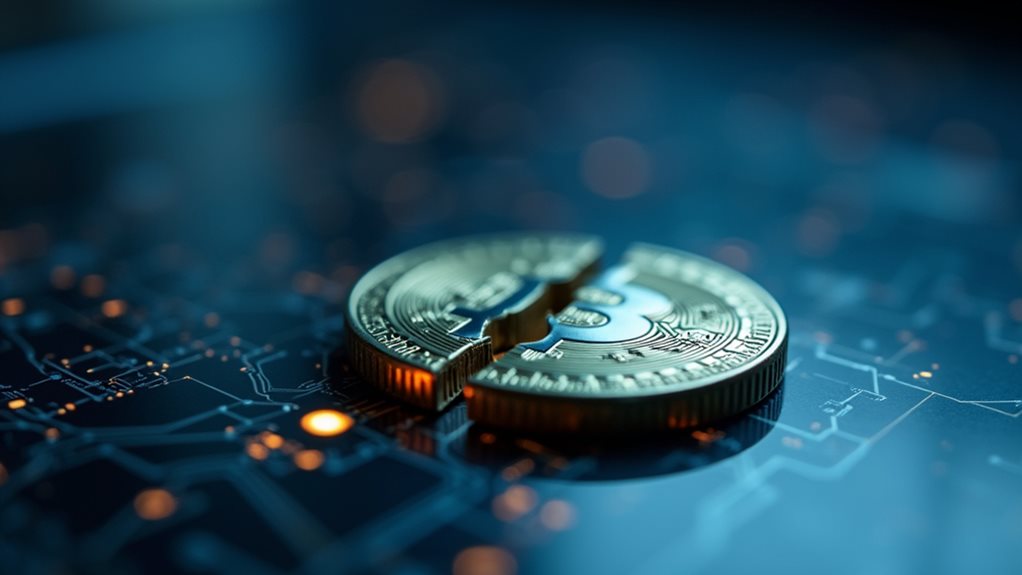
Cryptocurrency forks split a blockchain into two separate paths. You’ll encounter hard forks (creating entirely new coins like Bitcoin Cash), soft forks (backward-compatible upgrades like SegWit), and accidental forks (temporary chain splits). During forks, you might receive “free” tokens based on your holdings, but expect wild price swings and market chaos. Not all forked coins survive long-term. Smart investors examine developer commitment, community support, and transaction volumes before getting excited about that shiny new coin.
What Are Cryptocurrency Forks: Hard vs. Soft vs. Accidental

When you immerse yourself in the world of cryptocurrencies, you’ll inevitably encounter forks. They’re basically blockchain divergence events—moments when the network splits or upgrades.
Hard forks are the dramatic ones. Non-backward compatible. Bitcoin Cash, anyone? They create entirely new cryptocurrencies when consensus rules change dramatically. Everyone must upgrade or get left behind on the old chain.
Soft forks play nicer. They maintain backward compatibility while implementing new features. SegWit? That’s a soft fork. Old nodes still function, even if they miss out on new goodies.
Then there’s accidental forks—blockchain’s awkward moments. Two miners solve blocks simultaneously and—oops—temporary split! Don’t worry, these resolve themselves through cryptocurrency governance mechanisms. These temporary forks naturally resolve when one chain eventually becomes longer through consensus rule application. For asset protection, always ensure you control private keys during any type of fork event.
Understanding forks matters. They affect transaction history, create new assets, and sometimes reveal deep ideological rifts in crypto communities.
No big deal, just the future of money evolving in real-time.
The Technical Mechanics Behind Blockchain Forks

To truly grasp how cryptocurrency forks work, you’ve got to peek under the hood at their technical mechanics. Forks don’t just happen—they require careful planning and execution.
The process kicks off with a proposal, followed by heated community consensus discussions. Fork governance isn’t pretty. It’s messy, political, and sometimes downright ugly. During this phase, users and developers must choose which forked chain to support based on their preferred vision for the blockchain’s future.
Once stakeholders agree (or don’t), developers get to work implementing changes:
- Coding new protocols that either break compatibility (hard fork) or maintain backward compatibility (soft fork)
- Testing these changes rigorously—nobody wants a billion-dollar mistake
- Executing the split, creating two separate chains with identical histories up to the fork point
After the split? Both chains need maintenance. One might thrive, the other might die. That’s crypto for you—constant evolution or extinction. Hard forks can create entirely new cryptocurrency assets that trade independently of the original blockchain.
Historical Impact of Major Cryptocurrency Forks

Throughout crypto’s tumultuous history, forks have repeatedly changed the game—sometimes spectacularly, sometimes disastrously.
Bitcoin’s early forks like XT and Classic bombed, but they exposed the raw community dynamics that would define crypto governance forever. With market dominance at 74%, Bitcoin has proven its resilience against competing forks.
Then came Bitcoin Cash in 2017—the fork that actually stuck—splitting the community over a simple question: bigger blocks or off-chain solutions? Spoiler: neither side truly “won.” Bitcoin Cash gained initial attention for its promise of faster transactions and lower fees, supported by influential figures like Roger Ver.
When ideology meets technology, communities split and solutions falter. The crypto revolution devours its own.
The drama intensified when Bitcoin SV forked from Bitcoin Cash in 2018. More ideology, more promises, more disappointment.
These successive splits diluted community cohesion and, frankly, investor patience.
The historical significance can’t be overstated. Each fork revealed how technical disagreements quickly become religious wars.
Decentralization sounds great until you need everyone to agree on something.
Ethereum’s hard fork in 2016 created Ethereum Classic after the community was divided on how to respond to the DAO hack.
How Forks Create New Investment Opportunities

Despite their contentious nature, cryptocurrency forks present remarkable opportunities for savvy investors willing to steer through their choppy waters. When a blockchain splits, you’re fundamentally getting free money—new forked tokens appear in your wallet based on your holdings. No extra investment required. Pretty sweet deal, right?
These events create multiple avenues for portfolio growth:
- Asset multiplication happens automatically—one coin becomes two, instantly diversifying your crypto holdings.
- Competition between chains drives innovation, potentially increasing the value of both original and forked assets.
- Volatility around fork events creates prime conditions for various investment strategies, from arbitrage to long-term holds.
The market goes nuts during forks. Prices swing wildly. Trading volume explodes. Smart investors watch these patterns and position accordingly. Hard forks often lead to significant market price volatility as users adjust to the new landscape. Soft forks typically provide a less disruptive option for blockchain upgrades while maintaining network stability.
Navigating Market Volatility During Fork Events

When cryptocurrencies fork, market volatility doesn’t just increase—it explodes. Price swings become wild, unpredictable beasts.
You’ll notice surges before the fork (everyone wants in) and sharp drops afterward (hello, profit-takers).
Trader psychology turns chaotic. Some buy to grab those shiny new forked coins. Others bail completely. Can you blame them? Market speculation reaches fever pitch, with volumes spiking as everyone repositions their bets. Similar to panic selling behavior seen in traditional bear markets, emotions often drive investment decisions.
This volatility isn’t just a one-day affair. Expect up to three days of price rollercoasters post-fork. Research shows that volatility remains significantly elevated for three days following fork events. Community divisions don’t help—when developers argue, your portfolio suffers.
Exchanges get overwhelmed. Liquidity fluctuates. Your once-stable coin suddenly acts like it’s had too much caffeine.
The Bitcoin Cash fork in 2017 demonstrated how contentious forks can trigger extreme price fluctuations across the entire cryptocurrency market.
And yes, sometimes this crypto drama spills into traditional markets. Fun times.
Tax and Legal Considerations for Fork-Generated Assets
If you thought trading crypto was complicated, the tax implications of fork-generated assets will make your head spin. The IRS doesn’t care about your confusion—they want their cut. When you receive new coins from a hard fork, you’re on the hook for ordinary income tax based on the fair market value at receipt. Period.
The compliance challenges aren’t simple. Remember these critical points:
Navigating crypto tax compliance is like defusing a bomb with chopsticks—technically possible but fraught with expensive mistakes.
- You’re only taxed when you have “dominion and control” over the new coins—meaning you can sell or transfer them.
- Your basis in the new cryptocurrency equals the FMV you already paid taxes on.
- Soft forks aren’t taxable events, but hard forks with new coins are.
Keep meticulous records. The IRS is watching, and they’re not known for their sense of humor about missing crypto income. For peer-to-peer transactions, taxation applies when New Coins can be used in a transaction without requiring further action from you or third parties. Although hard forks create taxable events for new coins, your existing assets are not treated as disposed of when a fork occurs.
Evaluating a Fork’s Long-Term Viability

Beyond tax nightmares, you’ll need to figure out if that shiny new forked coin will survive or end up in crypto’s growing market graveyard. Not every fork is created equal.
Hard forks create entirely new assets—risky business. Soft forks? Less dramatic.
Watch the community engagement after the split; fragmented communities rarely thrive. A dedicated development team isn’t optional—it’s crucial. The persistence of both chains after a hard fork split represents a permanent divergence in the protocol’s evolution.
Market adaptability matters too. Can this fork adjust to regulatory hurricanes? Does it solve actual problems or just exist because some developers got cranky? With quantum computing threats looming on the horizon, security innovations are essential for long-term survival.
Look at transaction volumes and institutional support. Empty blockchains aren’t worth your time.
The hash rate distribution tells you everything. When miners abandon ship, that’s your canary in the coal mine.
Sure, some forks flourish. But most? They fade into obscurity, taking investor hopes with them.
Consider implementing a HODL strategy for established post-fork assets like Bitcoin Cash rather than attempting to time volatile markets.
Key Warning Signs of Problematic Fork Projects

Not all that glitters in the crypto world deserves your attention.
Being able to spot investor red flags in crypto forks could save your portfolio from disaster. Communication breakdowns between development teams and communities often signal trouble brewing. Projects without clear vision or direction typically fail to maintain community support and rarely achieve long-term success. Proper tax reporting of crypto transactions is legally required, even for fork-related assets. Utilizing hardware wallets provides essential security against potential fork-related scams and hacks.
Watch out for these warning signs:
- Technical shortcomings: No MVP, unresolved bugs, and zero improvements over the original protocol. Seriously, what’s the point?
- Dishonest marketing tactics: Unrealistic promises, fake partnerships, and the classic “guaranteed returns” nonsense. Yeah, right.
- Community issues: Censorship of criticism, forced hard forks, and adoption barriers with major platforms.
Transparency matters.
When project leaders won’t show their faces or respond to questions, they’re usually hiding something worse than their coding skills. Adoption doesn’t lie.
Practical Steps for Investors Before, During and After Forks

Knowing the warning signs of sketchy forks won’t help much without a concrete game plan. Your fork preparation should start with staying informed—follow announcements, understand the differences between hard and soft forks, and get your wallets ready.
Seriously, nothing worse than being caught with your crypto pants down.
During the fork? Stop transactions temporarily. Pull funds from exchanges that might flake on supporting both chains. Remember that hard forks create permanent blockchain divergence, unlike soft forks which maintain backward compatibility.
Watch the community chatter like a hawk.
Afterward, claim any new tokens you’re entitled to and manage assets on both chains. Remember replay protection—it’s not merely techno-jargon.
Market strategies must adapt to volatility. Prices will swing wildly. That’s just how it goes.
Just as Ethereum processes blocks every 10-20 seconds, fork transitions can happen quickly, so stay alert and ready to act.
Stay informed, monitor sentiment, and adjust accordingly.
Be aware that receiving new tokens from hard forks creates taxable income based on their fair market value at the time of receipt.
Frequently Asked Questions
Can I Control Which Fork My Crypto Wallet Supports?
No, you can’t directly control fork selection. Wallet developers determine which forks they’ll support through updates. Your only options are choosing wallets with compatible fork support or moving assets between different wallet platforms.
How Do Exchanges Decide Which Forks to List?
Exchanges assess forks based on market demand, community support, trading volume, security, and regulatory compliance. You’ll notice they evaluate a fork’s technology, development team, and use cases during their exchange criteria and fork evaluation process.
Do Smaller Cryptocurrencies Experience Forks Like Bitcoin and Ethereum?
Yes, smaller cryptocurrencies do experience forks, though their fork frequency is typically lower than Bitcoin or Ethereum. You’ll notice these forks have more localized impact but follow similar mechanisms of community disagreement or protocol upgrades.
Can a Failed Fork Attempt Damage the Original Cryptocurrency?
Yes, failed fork attempts can damage the original cryptocurrency. You’ll notice decreased original value, negative community impact, and cautious investor sentiment when implementation issues or consensus failures occur during a blockchain upgrade.
How Do Forks Affect Decentralized Applications Built on the Blockchain?
Forks can disrupt your dApp compatibility, requiring code updates and infrastructure changes. You’ll face community fragmentation, security concerns, and potential market volatility, but they also create innovation opportunities to improve your dApp’s functionality.