
To dodge high crypto exchange fees, choose platforms like Binance or KuCoin with rates starting at 0.1%. Always use limit orders instead of market orders – you’ll qualify for lower maker fees. Hold exchange tokens for discounts (25% with BNB, up to 50% with OKB). Consolidate your trading on one platform to reach volume-based fee tiers. Time your withdrawals during low network congestion. Those tiny percentage points add up fast, trust me.
Understanding Exchange Fee Structures
When you’re traversing the crypto environment, exchange fees can eat into your profits faster than you might realize. Seriously, these fees add up.
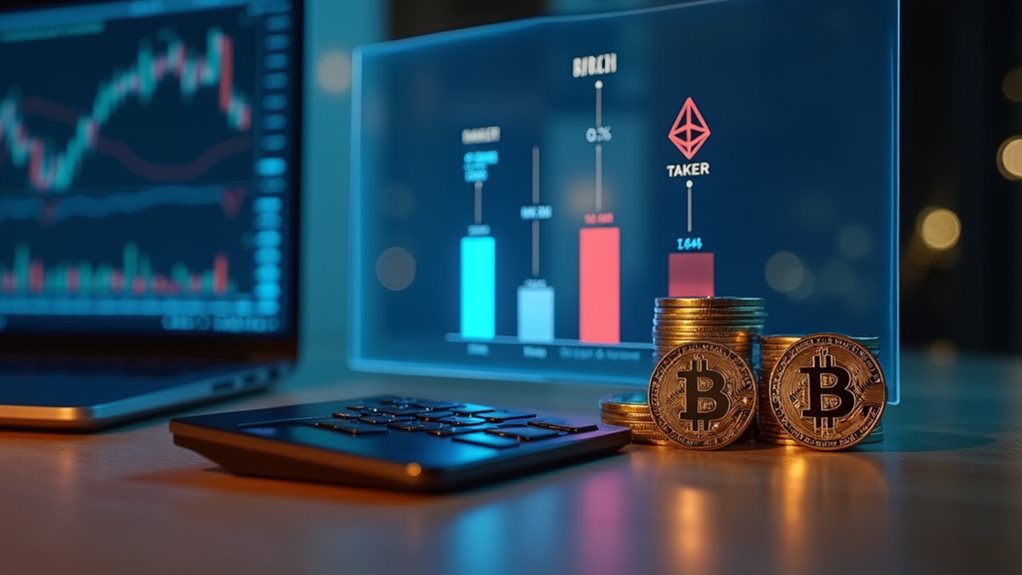
Understanding maker and taker fees is vital. Makers place limit orders that wait on the books—they provide liquidity. Takers grab existing orders immediately—they take liquidity. Guess who pays more? Yep, takers.
Makers wait. Takers execute. The liquidity game determines who pays the premium in crypto trading.
Fee rates vary wildly between exchanges. Some charge makers 0.055%, others 0.2%. Same deal with taker fees (0.065% to 0.2%). Many platforms offer VIP tiers based on your trading volume. Trade more, pay less. Simple. Popular exchanges like Binance.US offer significant savings with fees as low as 0.10%.
Fee transparency is often… let’s say lacking. Don’t just jump at the first exchange you see. A proper fee comparison between platforms could save you hundreds. Maybe thousands.
The difference between maker and taker fees? That’s how exchanges encourage liquidity. Smart, right? Some platforms like Gate.io implement tiered fee structures that reward users with substantially lower rates at higher VIP levels. Always consider withdrawal fees when choosing an exchange, as these costs apply whenever transferring coins out.
Best Low-Fee Exchanges for Trading Crypto
Now that you know how fees work, let’s look at where you’ll pay less.
Binance offers rock-bottom rates, especially when using BNB. Starting at 0.1% with further discounts? Yes, please. U.S. traders must use Binance.US platform for their crypto transactions due to regulatory requirements.
KuCoin matches that 0.1% base rate while rewarding KCS holders with extra savings. Smart.
OKX follows the tiered discount approach – higher volume equals lower fees. Period.
Kraken balances compliance with reasonable costs across 500+ cryptocurrencies. Not bad for an old-timer established in 2011.
For diverse token access without breaking the bank, check MEXC with its 1600+ cryptocurrencies and tiered KYC.
Exchange reputation matters here. Some platforms like CoinEx offer no-KYC options with low fees, but there’s always a tradeoff.
Your user preferences matter. Want regulatory compliance? Specialized discounts? Rare tokens? Choose accordingly.
Bybit frequently runs zero-fee campaigns for retail traders while maintaining its competitive maker rebates for derivatives trading.
Coinbase, though charging between 0% to 4%, offers beginners a user-friendly platform with over 200 cryptocurrencies to choose from.
The Difference Between Maker and Taker Fees
Understanding maker and taker fees matters more than most crypto traders realize. These aren’t just random numbers on your transaction receipt—they directly impact your bottom line.
Maker fee advantages are substantial. When you place limit orders that sit on the books, you’re adding liquidity to the market. Exchanges love this. They’ll reward you with lower fees—sometimes even rebates. Smart move.
Taker fee disadvantages? They’ll cost you. Placing market orders that execute immediately means you’re snatching liquidity away. Exchanges charge more for this convenience. Immediate execution isn’t free, folks. Peak trading hours between 2:30 PM and 4:30 PM UTC typically see the highest taker fees due to increased market activity.
The difference is simple: patience saves money. Want to pay less? Be a maker. Need it now? You’re a taker—and you’ll pay for that privilege. The bid-ask spread can provide additional profit opportunities for market makers beyond the fee advantages.
Your trading strategy matters. Different exchanges offer varying fee structures depending on your trading volume, with higher-volume traders typically qualifying for reduced rates.
Using Limit Orders to Reduce Trading Costs
Limit orders might be your best-kept secret for slashing crypto trading costs.
They’re not merely fancy trader tools—they’re your financial bodyguards against market volatility.
Unlike market orders that burn money with taker fees, limit orders typically give you “maker” status. Lower fees. Period.
The limit order benefits extend beyond merely controlling your exact entry price—they completely eliminate the slippage that eats your profits.
Strategic execution is everything. Place orders at support levels during dips. Wait for the market to come to you.
Yes, you might occasionally miss a trade, but you’ll never overpay again.
Using hardware wallets alongside limit orders adds an extra layer of security to your trading strategy.
Remember this: exchanges love impatient traders who pay premium fees for immediate execution.
Don’t be that sucker. Set your price. Make the market work for YOU.
When using limit orders, you gain precise trading strategy that helps you manage risks effectively in the volatile crypto environment.
Limit orders provide SIPC insurance protection for your investments against brokerage firm failure, though this doesn’t cover market-related losses.
Fee Discounts Through Exchange Native Tokens
While trading crypto normally costs an arm and a leg, savvy traders slash their fees using exchange native tokens.
Simple hack, massive savings.
Think about it. Binance gives you 25% off spot trading when you pay with BNB. OKX? Up to 50% discount with their OKB token. Not pocket change.
Native token benefits extend beyond just savings. Many exchanges created tiered discounts that reward bigger hodlers. WOO token users can reach actual zero-fee trading at 1,800 tokens. That’s right. Zero. Unlike spot ETF investments, these tokens require more technical knowledge to manage properly.
The math is obvious. Hold native tokens, pay less to trade. Some tokens double as governance tools or yield farming assets. Multi-purpose utility.
Not all exchanges play this game, though. Coinbase and Kraken? No native token discounts. Their loss, your problem. Enthusiastic traders can still qualify for VIP tier programs based on their 30-day trading volume without needing specific tokens.
Specialized platforms like Strike and River offer 0% trading fees exclusively for Bitcoin, making them ideal options for BTC-only investors.
Volume-Based Fee Tiers and How to Qualify
Beyond native tokens, savvy traders can slash fees even further through volume-based tier systems.
It’s simple math—trade more, pay less. Most exchanges reward high-volume traders with dramatically reduced fees, sometimes dropping from 0.1% to a measly 0.02%.
The catch? You’ll need serious volume. Entry-level tiers typically start around $1 million monthly. Yeah, not exactly pocket change. Top tiers? Try $50-500 million. Ridiculous.
For fee optimization, consolidate your trading on one exchange instead of spreading it thin. Prefer limit orders—they qualify as “maker” fees, which are cheaper than “taker” fees. The maker-taker fee model incentivizes liquidity provision while penalizing those who remove it from the order book. Platforms like Kraken Pro specifically implement this model with fees based on your 30-day trading volume.
Track your monthly volume religiously. Just 30 days of slacking, and you’re back to paying premium rates.
For casual traders? These volume tiers are mostly fantasy land. But hey, something to aspire to.
Centralized vs. Decentralized Exchanges: Fee Comparison

When it comes to exchange fees, the battle between centralized and decentralized platforms isn’t even close to straightforward.
CEXs offer trading speed and liquidity advantages but charge higher fees to cover their security infrastructure.
Meanwhile, DEXs might seem cheaper upfront until gas fees hit your wallet. Surprise!
Fee transparency varies wildly between platforms. DEXs let you keep your keys—and all the user responsibility that comes with it. Some CEXs provide insurance for funds in case of security breaches, which partially justifies their higher fees. Many exchanges offer discounts of up to 25% when paying fees with their utility tokens. With recent market volatility causing massive liquidations, choosing a reliable exchange is more critical than ever.
- CEX advantages include higher liquidity and volume-based discounts (pay with their token, save money)
- DEX disadvantages often boil down to liquidity challenges during market volatility
- Gas fees can make “cheap” DEX trades absurdly expensive (especially on Ethereum)
- Security concerns differ: CEXs risk hacks, DEXs risk smart contract failures
- Layer 2 solutions are making DEXs more competitive—finally!
Choose wisely. Your wallet’s at stake.
Minimizing Withdrawal Fees and Hidden Costs
Despite what exchanges might tell you, those sneaky withdrawal fees can absolutely destroy your crypto profits. Seriously. Some platforms charge ridiculous amounts while others offer zero fees. Do your homework.
Don’t let exchange withdrawal fees silently eat your crypto gains. Smart traders compare costs before moving assets.
For the lowest costs, choose exchanges like Phemex or Crypto.com with free withdrawals on certain coins. Timing matters too—weekends and late nights typically have lower network congestion. Less traffic equals cheaper fees. Simple math.
Proper wallet selection makes a huge difference. Transfer within the same exchange ecosystem whenever possible. Fee transparency isn’t just a fancy term—it’s your financial lifeline. Compare withdrawal costs before committing.
Consider using fee-free cryptocurrencies like Nano or IOTA for transfers. Or Stellar, with its microscopic $0.000004 transaction cost. VeChain is particularly cost-effective with an extremely low $0.001 fee for withdrawals. Dash is another excellent option with average transaction fees of only about $0.01 per transaction. Your future self will thank you.
Advanced Trading Strategies for Fee Optimization
Smart traders know that the difference between profit and loss often comes down to fees—not just avoiding them, but enhancing every single transaction. Fee arbitrage isn’t just for the pros anymore. You’re leaving money on the table if you’re not thinking strategically.
- Switch to limit orders instead of market orders—instant 50% fee reduction on most exchanges
- Leverage exchange tokens (hello, 20-50% discounts) to slash your costs
- Batch those tiny trades into larger ones—death by a thousand small-fee cuts is real
- Try algorithmic trading to execute at ideal fee times—computers don’t sleep or pay taker fees
- Spread trading across exchanges to exploit variable fee structures—why be loyal when it costs you?
The math is brutal: 1% fees on each trade can devour 25% of annual returns. Not cool. Remember that regular strategy reviews prevent complacency and help you adapt to changing fee structures across different platforms. With trading volume down 54% since December, now is the perfect time to optimize your fee strategy. Using Coinbase Advanced Trade could reduce your trading fees by up to 0.6% compared to standard Coinbase rates.
Frequently Asked Questions
How Do Different Payment Methods Affect Deposit Fees?
Your payment method dramatically impacts deposit fees. Bank transfers are typically free or low-cost, while credit/debit cards charge 2.5-8%. When comparing payment method options, understand different deposit fee structures to minimize costs.
Can Regulatory Changes Unexpectedly Impact Exchange Fee Structures?
Yes, regulatory changes can unexpectedly alter exchange fee structures. When governments issue new rules, exchanges often pass compliance costs to you through higher fees or completely revamp their fee models to maintain regulatory compliance.
Are Lower Fees Always Better, or Can They Indicate Security Risks?
No, lower fees aren’t always better. They can indicate security compromises. You’ll want to prioritize proper risk assessment over minimal costs, and look for exchanges offering fee transparency alongside robust security measures.
How Does Exchange Liquidity Affect the Real Cost of Transactions?
Low liquidity increases your real costs through higher slippage when trading. You’ll pay more than expected prices in thin liquidity pools, while deeper pools enable faster transaction speed with minimal price impact.
Do Hardware Wallets Offer Fee Advantages for Long-Term Crypto Holders?
Yes, you’ll benefit from hardware wallet benefits when holding crypto long-term. You’ll avoid exchange trading fees, recurring custody charges, and withdrawal costs—paying only network fees when you eventually move your assets from long term storage.