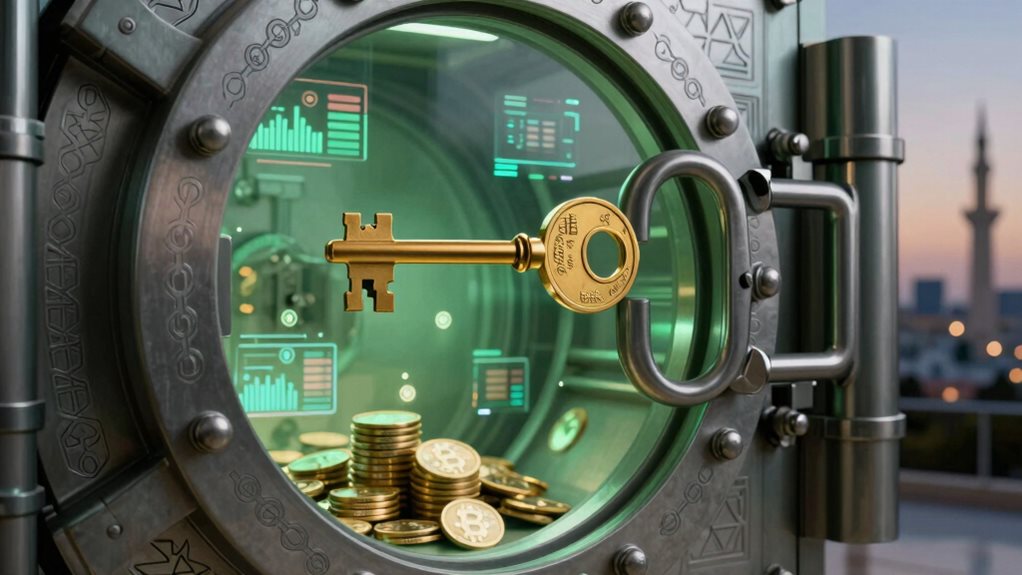

Public keys and private keys form the backbone of crypto security. Your public key’s like your address – share it freely so others can send you stuff. Your private key? That’s your golden ticket – lose it and you’re screwed. Never, ever share it. Think of it as a mailbox versus the key that opens it. Store private keys offline, preferably in hardware wallets. The difference between security and catastrophe often comes down to how you handle these digital keys.
The Essential Basics of Cryptographic Key Pairs

Cryptography’s secret sauce. It’s all about those key pairs—public and private—that keep your digital life from becoming everyone else’s business.
These aren’t random strings of gibberish. They’re mathematical marvels. Key generation relies on one-way functions. Easy to calculate forward, nearly impossible to reverse. Like making hamburger—try turning it back into a cow.
The algorithm complexity behind these keys is mind-boggling, using massive prime numbers multiplied together. Good luck factoring those.
Your public key? Share it. Whatever. The private key? Guard it with your life. Seriously. Once it’s exposed, game over.
The math linking them is elegant but brutal. The strength of this security comes from the Euler’s totient function that determines how your public and private keys relate mathematically. As computers get faster, we just make the keys bigger. Simple, really.
These key pairs form the foundation of security for everything from secure emails to cryptocurrency transactions.
The geeks call this “asymmetric cryptography.” You can call it “digital magic.”
How Public and Private Keys Work Together

While most people think of locks and keys as physical objects, the digital world operates on an entirely different playing field.
Your crypto security depends entirely on key pair interaction.
In the digital realm, your assets live or die by the sacred dance between public and private keys.
Here’s the deal: your public key encrypts, your private key decrypts. That’s asymmetric encryption in summary. Simple, right? Not quite.
When someone sends you data, they use your public key to secure it. Only you, with your private key, can access it. That’s the beauty of this system.
The math behind this is mind-bending. A one-way function makes it easy to go forward, nearly impossible to reverse.
Keep your private key secret. Seriously. Share your public key all you want. That’s the point. If your private key becomes known, it represents a chief security risk that can completely compromise your cryptographic security.
One exposed, one protected. That’s how they work together.
This system is fundamental to TLS/SSL protocols that secure your everyday browsing through HTTPS connections.
Protecting Your Private Keys: Best Security Practices

Now that you understand how your keys work together, let’s talk security. Private key management isn’t optional—it’s survival. Store your keys in Hardware Security Modules where they can’t be extracted. Period.
Never, ever share your private keys. Not with your mom. Not with your cat. Nobody.
For secure key storage, offline is king. Hardware wallets beat digital storage every time. Got digital copies temporarily? Encrypt them, then get them offline. Fast. Recovery phrases should be distributed across multiple secure locations for added protection.
Use multifactor authentication—passwords alone are a joke. And make those passwords ridiculous: 14+ characters, weird symbols, the works.
Consider using a durable metal card to store your seed phrase for protection against physical threats like fire or water damage.
Clear your clipboard after copying keys. Update your wallet software regularly. Consider multisig wallets for extra protection.
Remember: your keys, your coins. No keys, no coins.
The recent Bybit exchange hack resulting in 1.5 billion dollars stolen demonstrates why these security measures aren’t merely suggestions but necessities in cryptocurrency management.
Real-World Analogies for Understanding Key Security

Ever struggled to explain public and private keys to your non-crypto friends? It’s actually pretty simple.
Think of your public key as a physical lock anyone can close. You distribute it freely. No big deal. Your private key? That’s the unique key that opens it. Guard that thing with your life.
Lock analogies make crypto concepts click. Your public key is like your mailbox – everyone knows where to send stuff, but only you have the key to retrieve it.
Or consider your face (public) versus your fingerprints (private). People recognize you by looking, but can’t become you.
Proper key management comes down to one brutal truth: share your public key all you want, but expose your private key? Game over. Your crypto’s as good as gone. This approach reflects asymmetric cryptography, where one key encrypts while the other decrypts. The security of this entire system hinges on privacy of your private key.
The Role of Keys in Blockchain Transactions

Moving from analogies to the real thing – your keys aren’t just concepts, they’re powerful tools that make blockchain work.
When you send crypto, your private key creates a digital signature unique to that transaction. No key, no access. Simple as that.
Using hardware security modules can provide an extra layer of protection for your private keys and digital signatures.
This signature proves you’re the rightful owner without revealing your actual private key. Clever, right?
Meanwhile, the blockchain network uses your public key for transaction verification. It confirms your signature is legitimate without needing to know your secret key.
The beauty of key derivation is that while public keys come from private keys, the reverse is mathematically impossible.
Your keys aren’t just digital numbers – they’re the absolute authority on who owns what in the blockchain. No questions asked.
Compressed public keys help reduce transaction sizes by storing only the x-coordinate and parity of y-coordinate, making Bitcoin transactions more efficient.
The security of this system relies on complex mathematical techniques related to information security that ensure confidentiality and prevent unauthorized access to your assets.
Frequently Asked Questions
Can Quantum Computing Break the Public-Private Key Cryptography System?
Yes, quantum computers will eventually break current public-private key systems using Shor’s algorithm. You’ll need quantum-resistant cryptography advancements to protect your data from these inevitable quantum threats within the next decade.
How Often Should I Rotate or Change My Private Keys?
You should rotate your private keys every 6-12 months as a standard practice, and immediately if you suspect compromise. Implement regular key rotation as part of your security practices to minimize potential exposure risks.
Are Multi-Signature Wallets More Secure Than Single-Key Wallets?
Yes, multi-signature wallets are generally more secure. You’ll benefit from multi signature advantages like distributed control and elimination of single points of failure, which directly addresses the inherent single key vulnerabilities of traditional wallets.
Can Private Keys Be Recovered if My Hardware Wallet Is Damaged?
Yes, you can recover your private keys if your hardware wallet is damaged. You’ll use your saved recovery phrase to restore access on a new device. Always keep secure wallet backups for key recovery.
How Do Deterministic Wallets Generate Multiple Keys From One Seed Phrase?
Deterministic wallets use your seed phrase generation as the initial entropy source, then apply key derivation methods in a hierarchical structure. They mathematically derive unlimited private-public key pairs through a consistent algorithm that follows standardized derivation paths you can reproduce anywhere.